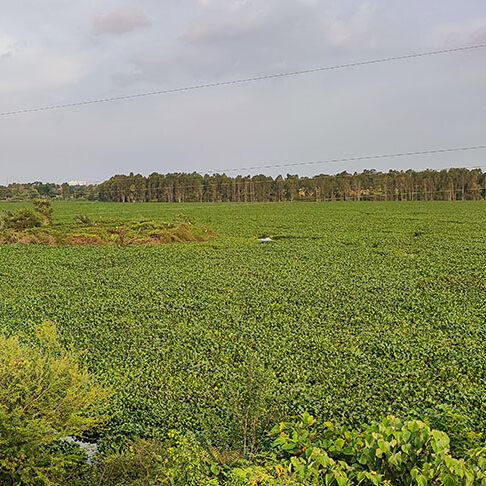
Water Hyacinth: Menace to blessing INTRODUCTION Water hyacinth is one of the fastest-growing plants known to us. It has the ability to procreate by seeds as well as vegetative by runners. A single plant can create over 3000 offspring in 50 days and double the area it is spread over in less than 12 days. Given the right conditions, each plant can spread over 600 sq. mt. in a year. The uncontrolled growth of this weed adversely affects water bodies. Dense mats formed by weeds over the water surface choke the water bodies, blocking sunlight from native plants and denying oxygenated water to the animals living in the water. As the plants die, the degradation of plant bodies sharply increases the nutrient level in the water. Biomass that sinks in the water decomposes anaerobically producing methane, a gas 80 times more potent as a greenhouse gas than carbon dioxide. Evapotranspiration due to water hyacinth also leads to water loss at 2-3 times the rate of clear water. Scientists have been trying to find ways to control the weed for more than two centuries, without success. Water hyacinth is a very hardy plant, able to not just grow but flourish in waters contaminated with toxic organic and inorganic pollutants. The few natural predators of the plant, weevils and moths, are only present in its native land. The use of chemical weedicides to eliminate the weed has only led to the water getting contaminated with carcinogens and the water hyacinth back in its full glory after a few months. WHAT’S THE SOLUTION The only way to eliminate it seems to be to manually remove it from the water. But this requires a constant expenditure of money and the plants removed from the water need to be disposed of appropriately. The problem cannot be solved by merely moving it from one place to another. We are lucky that some of the very characteristics of water hyacinth that have made it the pest it is, also make it useful in many ways. The plant, given its extremely high rate of growth, can produce biomass at an astounding rate. It has been estimated that in a year water hyacinth can yield 200 tons of dry matter per hectare in relatively clean water and for water with a high concentration of sewage it yields 650 tons of dry matter. In this process, the plant absorbs carbon dioxide from the atmosphere. One hectare of water hyacinth can absorb approximately 18 tons of carbon dioxide per year. In addition, as the plant sources its nutrients for growth, it helps clean the water it grows in. Water hyacinth can absorb extremely toxic pollutants organic as well as inorganic which include heavy metals, pharma waste, etc. The toxic organic compounds absorbed by the plant are broken down and converted to harmless forms. The biomass of water hyacinth can be converted to nutrient-rich compost for agriculture that can replace chemical fertilizers. The anaerobic decomposition of water hyacinth creates biogas and a nutritionally concentrated slurry for use in agriculture. This is a little more expensive operation compared to the relatively simple composting of the weed. In addition to this, the water hyacinth stem has a very high-quality fibre that can be used as a replacement for jute, and bamboo. SAVING THE LARGEST LAKES OF BENGALURU Hennagara lake, spread over 700 acres and Muthanallur lake, spread over 600 acres are the largest lakes of Bengaluru after Bellandur lake. These were lakes where until 4-years ago the water was clean enough to drink. But the incessant inflow of industrial effluents, heavy metals, pharma waste, and other toxic chemicals has resulted in water that you would not be advised to touch. Lying outside BBMP limits, these lakes do not get any funding for projects to restore them and create systems to manage the pollution flowing into them. Vrikshamitra is trying to restore these lakes with a plan that includes the creation of a constructed wetland, phytoremediation using low-cost biologcal agents like water hyacinth, and finally, utilising the biomass created by the water hyacinth to help solve other problems. We are doing all we can to force the industries polluting the lake to stop but the legal process in India is notoriously slow. Our dear lakes may not be able to survive till the courts and regulatory agencies notice the problem and do something about it. As we cannot stop the inflow of industrial effluents, the implementation of the next best option of creating a low-cost biological system to absorb the toxins covering less than 5% of the lake’s surface area is essential. Hennagara and Muthanallur lakes, right now are covered by a mat of water hyacinth over 800 acres in area. This weed in itself is a sponge for pollutants. Removing it could provide low-cost alternatives for farmers and gardeners to use as fertiliser for their crops. We look forward to your support in all forms to help start this project.